
350,000 Daily Users, One New Government, and a Generational Opportunity
With PM Balen Shah‘s 100-point reform mandate freshly approved, Nepal’s AI trajectory just got its biggest tailwind yet — here’s what the data says and what it means for the Himalayan republic.
Something unprecedented is happening in Nepal’s digital landscape. Just days after a youth-led revolution swept out one government and installed a 35-year-old rapper-turned-politician as Prime Minister, approximately 350,000 Nepalis are quietly logging into AI chatbots every single day — a figure that is growing faster than anyone officially tracks.
On March 27, 2026, Balendra Shah (Balen) — whose Rastriya Swatantra Party won 182 of 275 parliamentary seats — was sworn in as Nepal’s new Prime Minister. His first Cabinet meeting approved a sweeping 100-point governance reform agenda built around digital transformation, faceless public services, and delivery-based governance. Within 100 days, Nepalis should be receiving passports, citizenship certificates, and driving licences at their doorsteps via a modernised postal network.
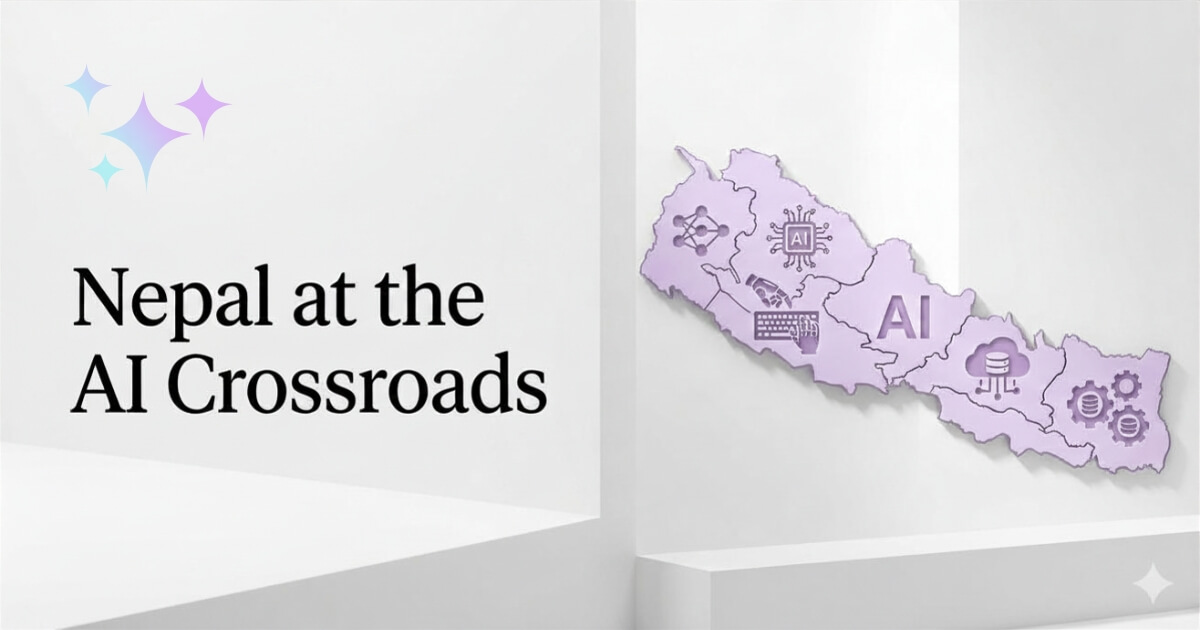
Simultaneously, Nepal’s National AI Policy 2082, approved in August 2025, and the National AI Centre, inaugurated in November 2025, form the institutional backbone for Nepal’s most significant technological leap. The question is no longer whether Nepal will adopt AI — it already has. The question is whether the state can harness that momentum.
Section 1: The Numbers
Where Nepal Stands in the Global AI Race
Globally, ChatGPT alone serves an estimated 160 million daily active users worldwide, with 900 million weekly. Google’s Gemini follows at 35 million DAU. Nepal, with roughly 16.5 million internet users — representing 55.8% of the population — is not absent from this story.
Nepal’s AI User Breakdown (Monthly Active Users, March 2026)
Modelled estimates · Source: DataReportal 2026 × global MAU share · Not officially published
OpenAI’s research reveals a critical insight: low-income countries show more than four times the AI chatbot adoption rate compared to high-income countries. Nepal, with a GDP per capita around $1,447, squarely fits this profile. When the ChatGPT Go plan launched in Nepal in October 2025, the effect was immediate. Claude‘s Nepal share reportedly tripled between January and February 2026 alone, while Gemini — deeply embedded in Android devices that dominate Nepal’s smartphone market — accounts for an estimated 22% of all Nepal AI users.
16.5 million internet users as of 2025. Growing annually, with 82.8% of mobile connections now broadband.
OpenAI’s finding: low-income nations adopt AI at 4× the rate of wealthy countries. Nepal firmly in this bracket.
Nepal’s official goal under the National AI Policy 2082: rank among the top 50 on the Global AI Readiness Index.
Nepal’s AI Policy mandates training 5,000 AI professionals with Excellence Centres in all 7 provinces.
Nepal’s AI Policy mandates training 5,000 AI professionals with Excellence Centres in all 7 provinces.
Section 2: The Policy Moment
A New Government, 100 Tasks, and a Digital Blueprint
PM Balen Shah‘s 100-point agenda, approved at the very first Cabinet meeting on March 28, 2026, is remarkable for its specificity — timelines of 5, 30, 100, and 1,000 days against named deliverables. Digital transformation runs through at least a quarter of the 100 points.
Earlier governments also issued sweeping directives from the top, but implementation faltered due to weak monitoring, a lack of ownership within the civil service, and poor coordination. That said, this government does appear more serious, with a clearer and more detailed work plan.
- Delivery-based governance Each ministry submits 7-day action plans with KPIs — the precondition for AI-driven public services.
- National Digital Governance Platform Unified digital backbone for all tiers of government — the critical infrastructure AI will run on.
- Faceless, time-bound public servicesPassports, citizenship, licences delivered via “Government Courier Service” within 100 days.
- National ID as universal identity Single identity for all state services — unlocks AI personalisation and targeted service delivery at scale.
- E-signatures and digital workflows Legal recognition of digital signatures across all government processes. Removes the final analogue bottleneck.
- Startup registration in 2 daysOne-door approval for major projects — makes Nepal viable for AI startup formation overnight.
- Tax automationDigitising Nepal’s Inland Revenue Department. AI-driven compliance, anomaly detection, and fraud prevention become government-ready.
- Anti-corruption asset investigationAI-based financial pattern analysis is the global standard for asset tracing — this mandate implicitly requires it.
Section 3: The National Ai Policy
The Architecture Nepal Already Has
On August 14, 2025, the previous administration approved the National Artificial Intelligence Policy 2082 — Nepal’s first dedicated AI law, led by the Ministry of Communication and Information Technology. On November 10, 2025, the National AI Centre was inaugurated. The policy is built around seven priority sectors: smart infrastructure, agriculture, health, tourism, education, finance, and governance.
🎓AI literacy from school level Mandatory AI curricula from primary school. Targets a nationwide AI-literate generation (5-yr target).
🏛️AI Excellence Centres in all 7 provinces Decentralised research hubs to prevent Kathmandu-centric AI development and reach mountain and Terai communities equally (In planning).
🌐Nepali language AI development The policy mandates AI tools in Nepali — closing the language gap that forces most Nepali users to operate in English (Priority)
💼AI startup seed capital & PPP investment Government-backed seed capital for AI entrepreneurs, PPP models for large projects, and NRN diaspora capital specifically mentioned (Framework set)
⚖️AI Regulatory Council and Governance Board Nepal’s AI oversight body to issue ethical guidelines, set standards, prevent algorithmic bias, and ensure data privacy (Operational)
Section 4: The Opportunity
Seven Sectors Where AI Can Transform Nepal
Companies like Fusemachines Nepal and Paaila Technology are already building AI-driven solutions. Here is where the biggest national opportunities lie:
🌾 Agriculture: AI for the 66%
Agriculture employs 66% of Nepal’s workforce. AI-powered crop disease detection, precision weather forecasting for smallholders, and AI-driven market price prediction could directly lift rural incomes.
🏥 Healthcare: Closing the Specialist Gap
An AI diagnostic assistant — even a basic symptom triage chatbot in Nepali — could extend healthcare reach into areas where specialists are absent. The AI Policy explicitly targets healthcare as a priority, and Nepal’s telemedicine infrastructure provides the connectivity backbone.
📚 Education: Personalised Learning at Scale
With over 7.5 million students in school, AI-powered adaptive learning could address Nepal’s crisis of rote learning. Nepali-language AI tutoring tools represent perhaps the single highest-return AI investment the government could make.
🏛️ Governance: The Balen Mandate
The 100-point agenda’s digital governance push is, in essence, a mandate to build Nepal’s government AI layer. The anti-corruption mandate explicitly requires financial pattern analysis at a scale only AI can perform. This is arguably the most immediate AI opportunity in Nepal today.
💰 Finance: Reaching the Unbanked
The World Bank estimates 82% of Nepal’s workforce is in informal employment. AI-powered credit scoring using alternative data could extend financial services to millions. Nepal’s remittance economy — over 26% of GDP — is uniquely suited to AI-optimised financial products.
🏔️ Tourism: Intelligent Nepal Experiences
The 100-point agenda includes “Nepal Wellness Year 2027”. AI-powered travel personalisation, multilingual chatbots, and real-time trekking permit and safety systems are immediately deployable wins.
🗣️ Nepali Language AI: The Unique National Asset
The AI Policy 2082 mandates Nepali-language AI development — a genuine first-mover advantage. A Nepali-language LLM would serve Nepal’s 30 million people plus the global Nepali diaspora. This is the kind of sovereign AI capability that justifies national investment.
Section 6 · The Path Forward
What the Next 1,000 Days Could Look Like
Conclusion
The Gen Z Revolution That Made AI Policy Possible
There is a deep irony in Nepal’s AI story. The September 2025 uprising that toppled KP Sharma Oli’s government was organised on the very AI-powered social media platforms the government had tried to ban. The Gen Z movement was itself a demonstration of digital empowerment in Nepal.
The Balen Shah government has the rare combination of a fresh mandate, a detailed digital plan, and a population already using AI. Nepal’s estimated 350,000 daily AI users — using ChatGPT, Gemini, Claude, and Perplexity — are not waiting for policy. They are already building habits and discovering what these tools can do.
The question for the next 1,000 days is whether the state can build fast enough to meet its citizens where they already are. If Nepal can digitise its services, fund its AI professionals, connect its rural population, and build in the Nepali language — the Himalayan republic has a genuine shot at something remarkable: a small nation that punched well above its weight in the AI era.
Note: Above contents are created and curated with the help of Claude.ai, Gemini, Chat-gpt by Ram Bhandari
